Presenters' biography
| Speaker 1 - Dr. Oleg Storozhenko (WHO Europe, GOARN DiSC) | ||
|---|---|---|
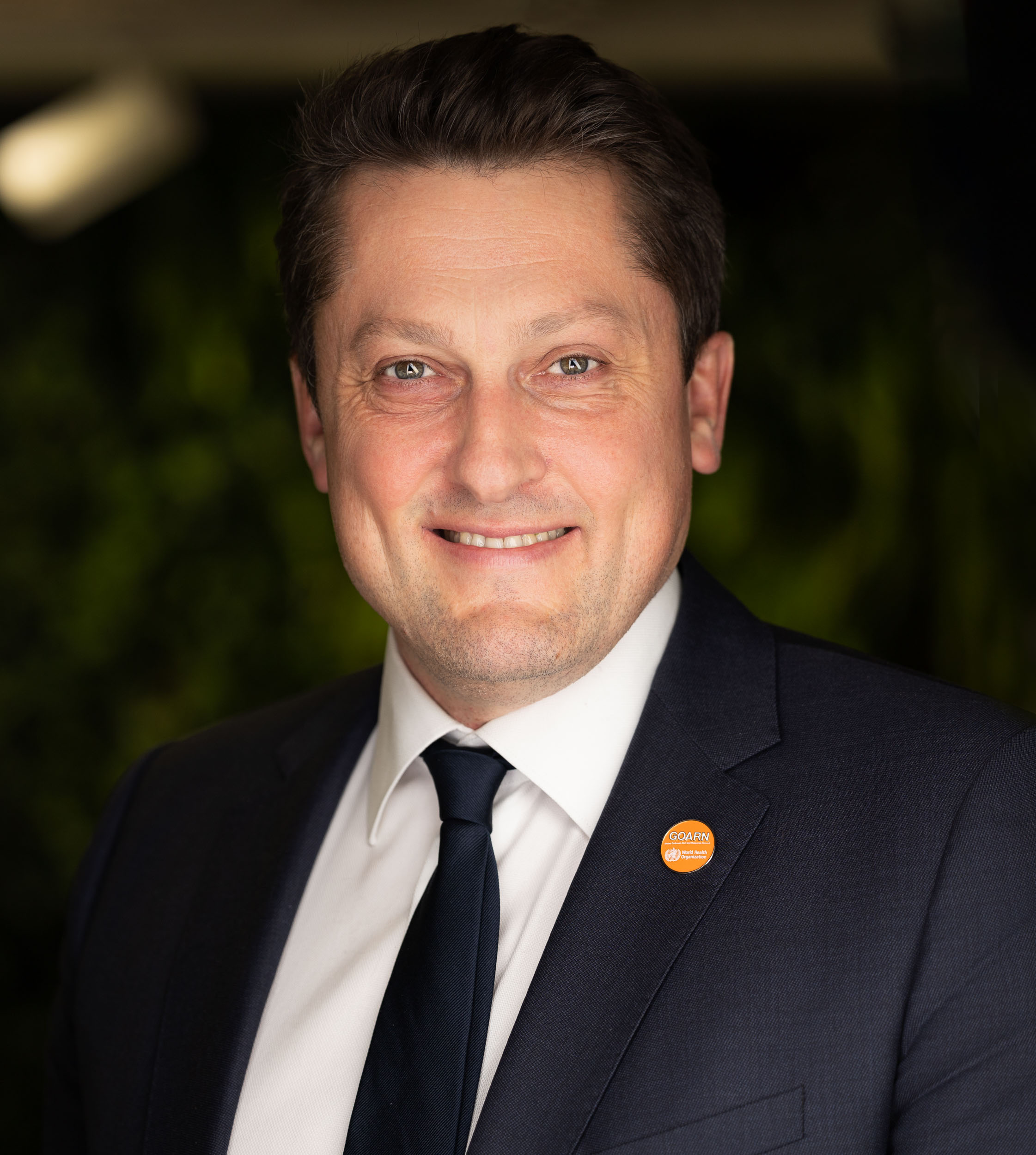 | Dr Oleg Storozhenko is a seasoned public health and emergency operations expert with over 20 years of international experience in health crisis response, epidemiology, and interagency coordination. He currently serves as Emergency Operations Team Lead at the WHO Regional Office for Europe in Copenhagen. In this role, Dr Storozhenko leads the development and regional scale-up of the Global Health Emergency Corps (GHEC) and oversees strategic coordination across major global response mechanisms, including the Emergency Medical Teams (EMT) Initiative, the Global Outbreak Alert and Response Network (GOARN) and its Strategic Group for Diagnostic Surge Capacities (GOARN-DiSC), as well as the Public Health Emergency Operations Centre Network (EOC-NET). He also spearheads the design and implementation of digital platforms and operational standards that enhance rapid response capacities and workforce deployment across the WHO European Region. A medical doctor by training with a Ph.D. in epidemiology, Dr Storozhenko brings extensive field experience from WHO country operations in Ukraine, Sierra Leone, the occupied Palestinian territory, and Central Asia, where he led and coordinated frontline responses to complex emergencies, including armed conflict, disease outbreaks, and protracted humanitarian crises. His contributions to key normative guidance—such as the WHO Minimum Operational Standards for RRMLs and the EMT Regional Action Plan 2024–2030—reflect his commitment to strengthening global emergency response systems and interagency coordination. | |
| Speaker 2 - Dr. Laurent Dacheux (Laboratory for Urgent Response to Biological Threats, Institut Pasteur, Paris, France) | ||
|---|---|---|
 | After training as a pharmacist, Laurent Dacheux quickly turned to research, obtaining a PhD in virology and then joining the Institut Pasteur as deputy director of the National Reference Center for Rabies in June 2004. After more than 20 years in this position, in mid-October 2023, he joined the Environment and Infectious Risks unit, still at Institut Pasteur, as a researcher. Within this unit, I also serve as deputy head of the Laboratory for Urgent Response to Biological Threats (CIBU). His current duties are therefore divided between public health and research activities. In terms of public health, these activities focus on microbiological diagnosis, mainly targeting threat agents and highly pathogenic or emerging microorganisms, organizing and taking part in the CIBU's 24/7 microbiological on-call service, developing and deploying the CIBU's mobile laboratory within the Rapid Response Mobile Laboratory (RRML) of the Global Outbreak Alert and Response Network (GOARN) - Diagnostic Surge Capacity network, etc. In terms of research activities, his main focus is on the study of zoonotic viruses (including lyssaviruses, coronaviruses, filoviruses, henipaviruses, poxviruses, etc.), from their detection using technological development (specific or multiplex serological tools, targeted or broad-spectrum molecular techniques, etc.) to the study of their infection mechanisms at the individual or cellular level (development of the most suitable cell lines). His main animal reservoir of interest is the bat, more recently extended to micromammals or rodents. | |
| Speaker 3 - Dr. Lucie Cappuccio (Laboratory for Urgent Response to Biological Threats, Institut Pasteur, Paris, France) | ||
|---|---|---|
 | She obtained her Ph.D. in 2020 in joint supervision between Université Claude Bernard Lyon 1 (France) and Chinese Academy of Science – Institut Pasteur of Shanghai (China) on Chikungunya virus infection in Human and mosquito models. She joined the Institut Pasteur as Research Engineer in the Unit Environment and Infectious Risks - Laboratory for Urgent Response to Biological Threats (WOAH Collaborating Center). She contributes to the Research Network against Epidemics project DURABLE to coordinate a global collaboration, from direct and indirect pathogen detection, evolutionary analysis and threat characterization, with One Health approach. | |
| Speaker 4 - Ms. Aurélia Kwasiborski (Laboratory for Urgent Response to Biological Threats, Institut Pasteur, Paris, France) | ||
|---|---|---|
 | Aurélia Kwsiborski is a Senior Research Engineer specializing in molecular biology and next-generation sequencing, with over ten years of experience in pathogen detection, genomic analysis, and molecular epidemiology. After completing an MSc in Molecular Biology and Biotechnology from AgroParisTech, Paris, France, she joined the Institut Pasteur in 2014 to work in the Genotyping of Pathogens Group within the Environment and Infectious Risks Unit, headed by Prof. Jean-Claude Manuguerra, where she contributes to the rapid identification and genetic characterization of pathogens during outbreaks. | |
| Speaker 5 - Mr. Rémi Vincent (Laboratory for Urgent Response to Biological Threats, Institut Pasteur, Paris, France) | ||
|---|---|---|
 | Rémi is a research engineer specialized in molecular biology with a strong expertise in next-generation sequencing (NGS), including wet lab to dry lab development of tools applied to pathogen detection and surveillance. After validating an engineering degree in biological engineering from the University of Technology of Compiègne (France), Rémi joined the Institut Pasteur in 2024 to reinforce the Genotyping of Pathogens Pole. His work principally focuses on: · Developing and implementing NGS solutions for rapid detection and characterization of diverse infectious agents, especially for field-deployed activities. · Public-health surveillance and pathogen characterization in humans, animals, and in the environment. · Emergency diagnostics supporting rapid responses to outbreaks and biological incidents. | |
Speaker 6 - Ms. Véronique Hourdel (Laboratory for Urgent Response to Biological Threats, Institut Pasteur, Paris, France) | ||
|---|---|---|
 | Véronique HOURDEL is a senior bioinformatician specializing in pipeline development for pathogen genomic surveillance and field next-generation sequencing. She holds a Master's degree in Biomathematics from the Université Denis Diderot (Paris 7, France). She gained extensive experience working for two biotechnology companies (Genset and Molecular Cytogenetic Labs) over a period of 10 years. During this time, she developed tools for genomic data analysis to study human disease and customized a chip for the diagnosis of neurologic pathologies (CGH array). In 2007, Véronique joined the Proteomics Core facility at Institut Pasteur, where she was responsible for all bioinformatics aspects of MS-based proteomics, from data generation to data analysis. In 2018, she joined the Environment and Infectious Risks research unit headed by Pr. Jean Claude MANUGUERRA, to work on the development and implementation of bioIT solutions for detecting and characterising pathogens in clinical, animal, and environmental samples in the field. | |
| |||||||||||||||||
|---|---|---|---|---|---|---|---|---|---|---|---|---|---|---|---|---|---|